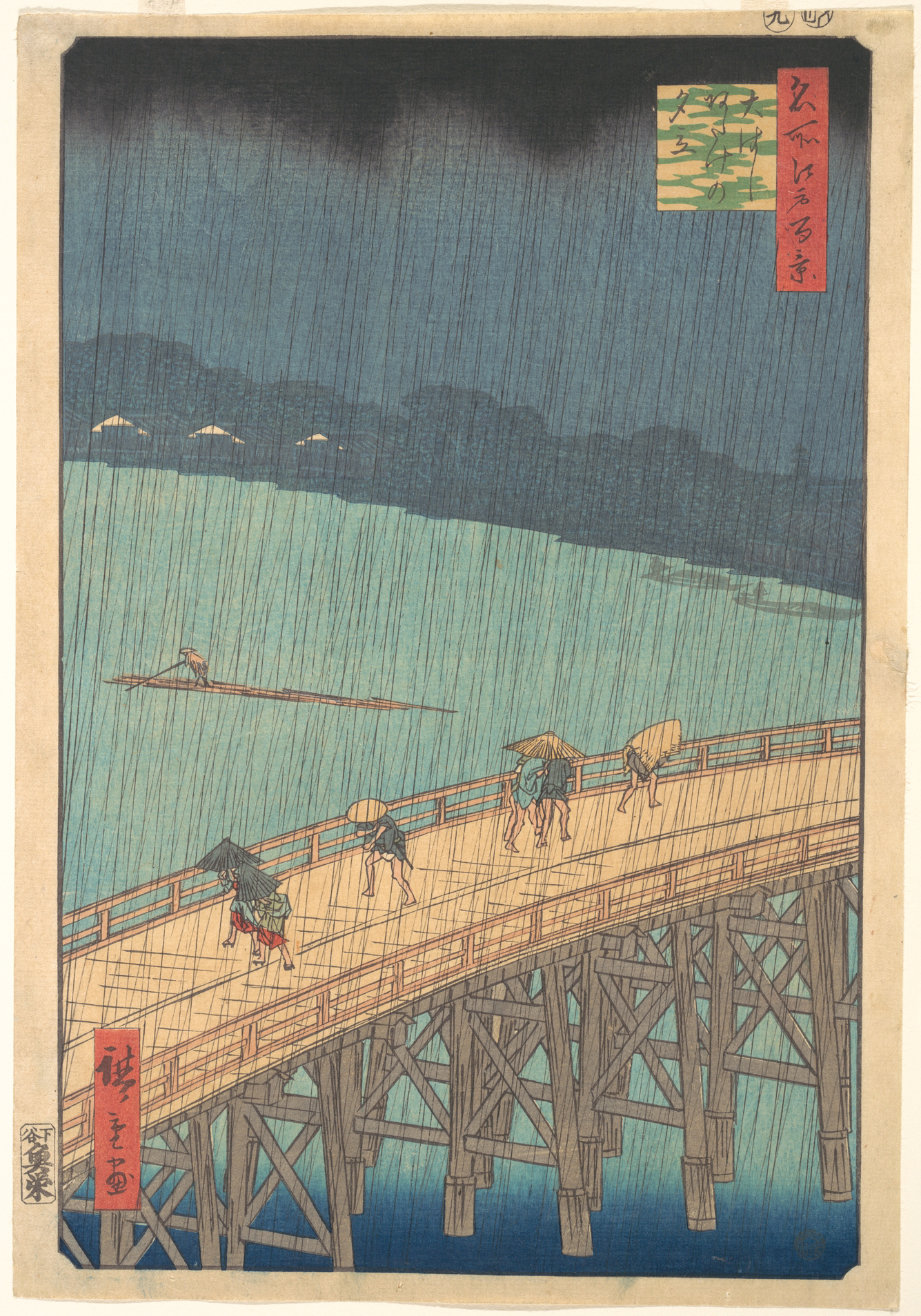
This is the first Tokyo Visual Note: a recurring series that begins with an existing work and turns close looking into a field exercise. The aim is not to imitate Hiroshige’s print as a photographic style. It is to identify decisions that still sharpen how we photograph rain, movement, and distance in Tokyo.
Hiroshige designed this view in 1857 as part of One Hundred Famous Views of Edo. The print is now in the public domain, and the image shown here is provided through The Metropolitan Museum of Art’s Open Access program.
Observation 1 — Rain is a direction, not a texture
The slanting rain lines organize the entire image. They do not sit on top as decoration; their angle presses against the long diagonal of the bridge and gives the shower force.
In a photograph, look for a background that makes rain legible: dark water, a shaded wall, or a distant building. Let shutter speed decide whether drops become short marks or disappear, but keep the direction of weather visible through umbrellas, clothing, spray, and movement.
Observation 2 — The bridge carries the eye before the figures do
The bridge cuts across the vertical sheet at a strong diagonal. Small figures become a rhythm along that structure, while the cropped foreground and distant bank create depth without a centered landmark.
For a field frame, choose the structural line first: a railing, crossing, platform edge, or reflection. Then wait for people to activate intervals along it. Avoid treating every umbrella as the subject; photograph the relationship between movement and the city structure.
Observation 3 — A narrow palette can still separate weather, water, and distance
Muted blue-gray, brown, green, and the pale unprinted paper create distinct layers. Restraint does not flatten the scene because value and temperature continue to separate foreground, river, bridge, and far shore.
In Lightroom, set exposure and white balance before reducing saturation. Protect the small difference between wet pavement and blue ambient light. Use a gentle curve for depth, and adjust individual colors only when they distract from the weather relationship. Do not add a yellow cast merely to make the photograph feel historical.
Field assignment — Make six frames in one shower
Photograph one directional rain pattern, one strong city diagonal, one sequence of moving people, one reflection that describes the sky, one frame with a distant weather layer, and one quiet moment after the rain changes.
Edit the six as a set. Keep exposure and white balance responsive to each frame, but use one shared tonal curve and restrained color direction. Sequence them from first evidence of rain to its aftermath, then write a factual one-sentence caption for each.
Sources and further reading
References for the context and techniques discussed in this field note.