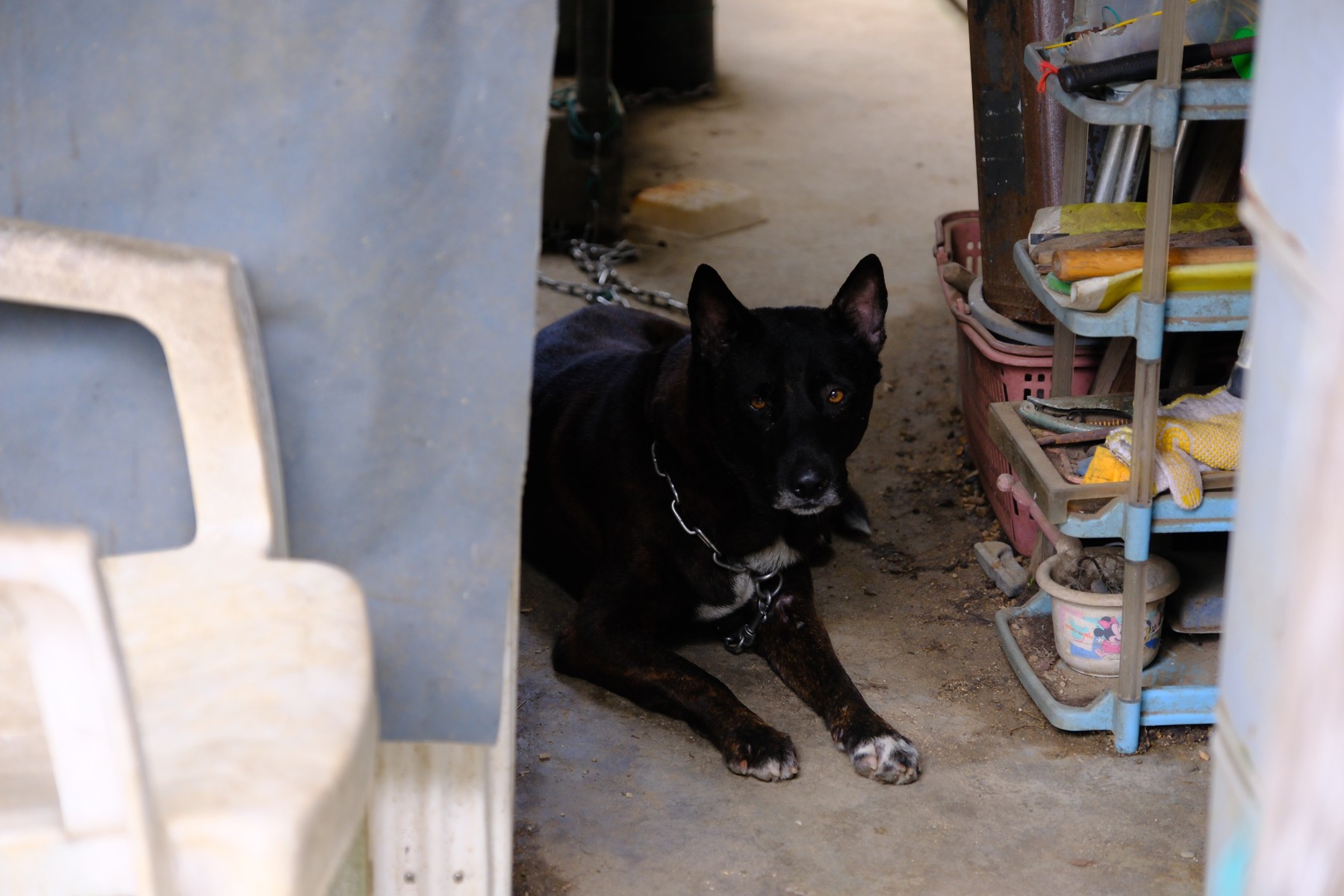
A dog may be still for half a second and turn its head as you release the shutter. A cat may sit in deep shade, where the camera can find a strong foreground edge instead of the eye. Solve movement, subject recognition, and depth of field as separate problems.
The X-H2 manual lists Animal subject detection for dogs and cats. It also distinguishes Single AF, which focuses when activated, from Continuous AF, which updates focus as distance changes. Detection is an aid, not evidence that the eye is sharp in every frame.
For a resting animal, place focus deliberately
Start with AF-S and a focus area on the near eye or the most important face detail. If the camera selects the wrong dark edge, resize or reposition the focus area and try again. For a profile view, the nose and near eye may sit on different planes.
Review an actual exposure at high magnification. A small screen can hide a missed eye. If you stop down for more depth of field, check that the resulting shutter speed is still fast enough for a sudden head movement.
For changing distance, use continuous focus
Switch to AF-C when the animal walks toward or away from the camera. Keep the chosen focus area on the subject and take short bursts at moments that matter, rather than assuming a long burst will rescue every frame.
Animal detection can help the X-H2 find dogs and cats; watch the displayed frame and return to a manually positioned focus area if the background or another animal wins. The X-H2 manual notes that enabling subject detection turns face/eye detection off.
Shutter speed is a different problem
Autofocus cannot freeze a moving paw or head when exposure time is too long. Raise shutter speed for movement, then let Auto ISO respond within a range you accept. For a still animal, you can trade some speed for lower ISO, but check the next movement rather than trusting the last pose.
Dark fur beside a bright chair also tests metering. Inspect the fur and chair separately; opening shadows later may add noise, while forcing every black surface gray can remove the animal’s form.
Cull for the photograph, not the green AF box
Compare the eye, whiskers or fur edge, expression, and body gesture at the output size. A camera focus indicator confirms an acquisition attempt, not a successful composition.
Keep only frames where the subject is clear enough for the intended use. In Lightroom, make local tonal corrections after selecting the best capture; sharpening cannot reconstruct a missed focal plane.
Sources and further reading
References for the context and techniques discussed in this field note.