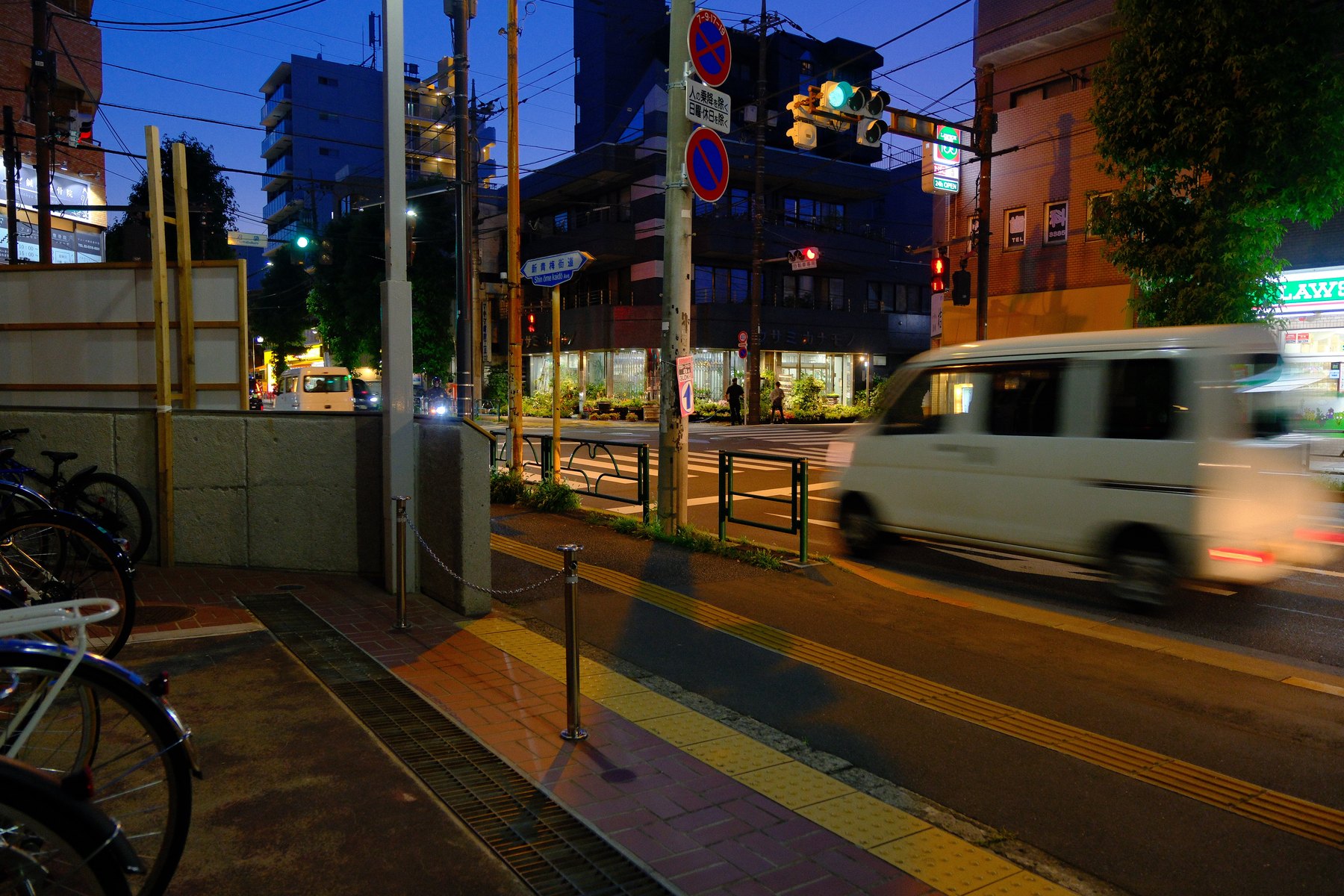
A moving vehicle can express the pace of an ordinary street without becoming a streak of anonymous light. The background must stay organized enough to make the movement legible.
Choose whether you want wheel and body movement, a partial streak, or a recognizable vehicle. Shutter speed follows that intention and the actual speed of traffic.
Build the still frame before waiting for motion
Use road markings, signals, building edges, or a curb as the stable structure. Compose a complete street photograph that can accept a vehicle without depending on it.
Keep a safe legal position and never step into traffic for the angle. Wait for repeatable movement from a fixed place.
Test blur one step at a time
Make a reference frame at a speed that holds the background, then lengthen exposure gradually. Review whether the vehicle remains recognizable and whether camera shake has entered the entire image.
Stabilization may help the stationary scene, but it cannot choose the shape of subject motion for you. Vehicle speed and distance change each result.
Preserve the blue-hour color relationship
Set white balance so the sky stays blue while lamps remain warm. Neutralizing either source completely can flatten the time-of-day cue.
In Lightroom, mask the vehicle only if its brightness or color pulls attention incorrectly. Avoid painting artificial light trails that were not captured.
Check signs and faces before publishing
Review the frame for readable private information and identifiable people. Crop or choose another frame when publication would create an avoidable privacy issue.
Record the actual shutter speed from metadata if you mention it. This photograph illustrates the method but does not establish one universal value.
Sources and further reading
References for the context and techniques discussed in this field note.