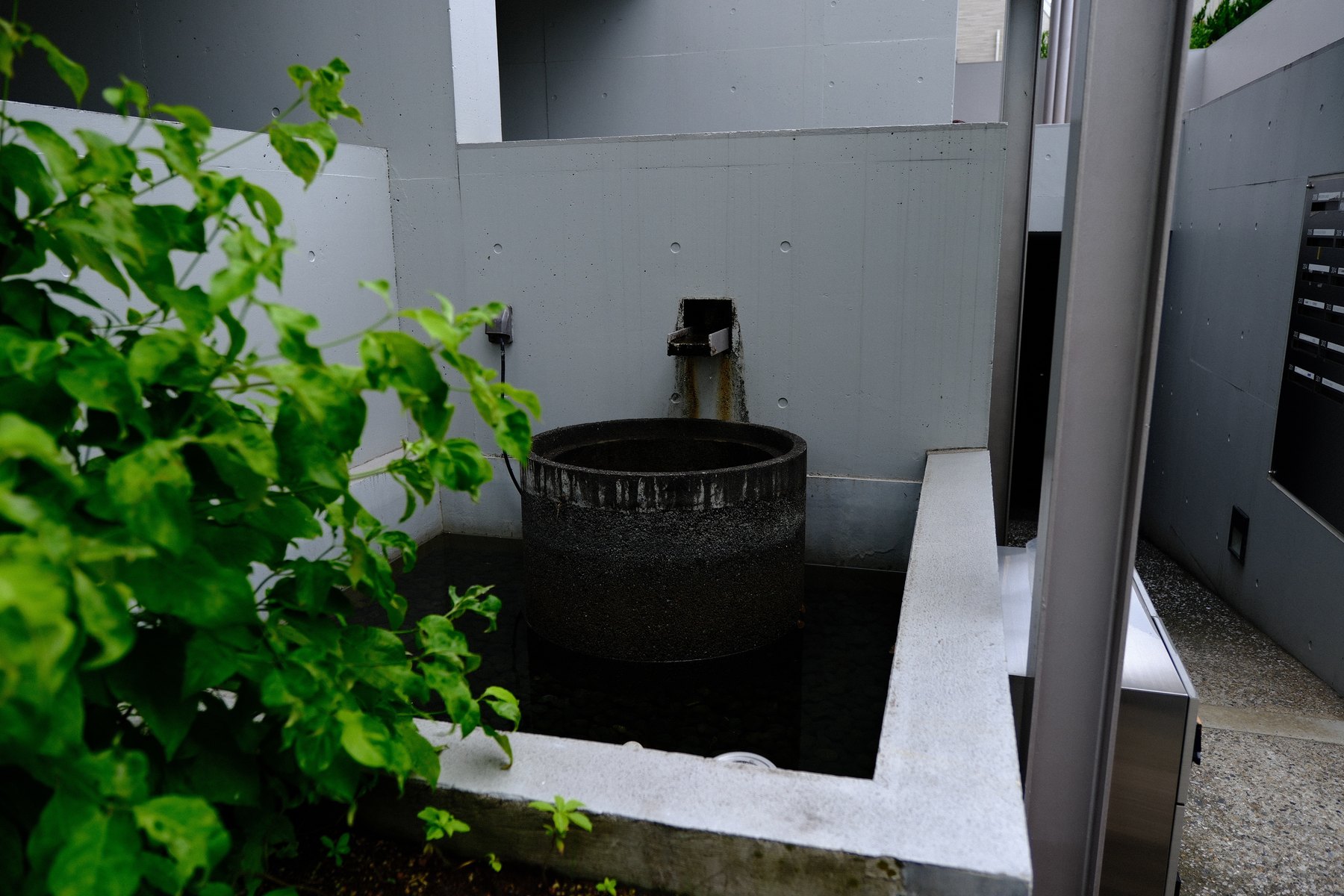
Concrete courtyards can look deceptively simple. A small green foreground, a rust stain, and a dark opening may occupy little area but define the depth and color balance of the whole frame.
If white balance drifts, neutral walls may turn blue or magenta while foliage becomes unnaturally electric. Establish the material relationship before applying a film look.
Use planes to explain the space
Align one dominant wall or edge, then let overlapping planes show distance. A perfectly centered frame is not required, but each crop should clarify how the viewer enters the space.
Watch bright wall edges near the frame boundary. They can become stronger than the dark water feature or architectural opening.
Set concrete before boosting foliage
Choose a profile and white balance that keep the main gray surface believable. Then judge whether the green needs adjustment; do not use foliage as the global white-balance reference.
Small rust or weather marks can confirm whether warmth is present in the material or introduced by the edit.
Separate green with targeted controls
Use Color Mixer or Point Color to adjust foliage without moving every yellow or cyan surface. Watch the reflected green in water and glass as part of the same scene.
A local mask can reduce foreground saturation or brightness if leaves dominate, but preserve natural variation inside the plant.
Keep texture subordinate to geometry
Texture and Clarity can reveal concrete pores but also make every wall harsh. Judge them at export size and preserve smooth tonal transitions.
Correct verticals only enough to remove distraction. Strong transforms can distort the circular feature or crop useful spatial cues.
Sources and further reading
References for the context and techniques discussed in this field note.