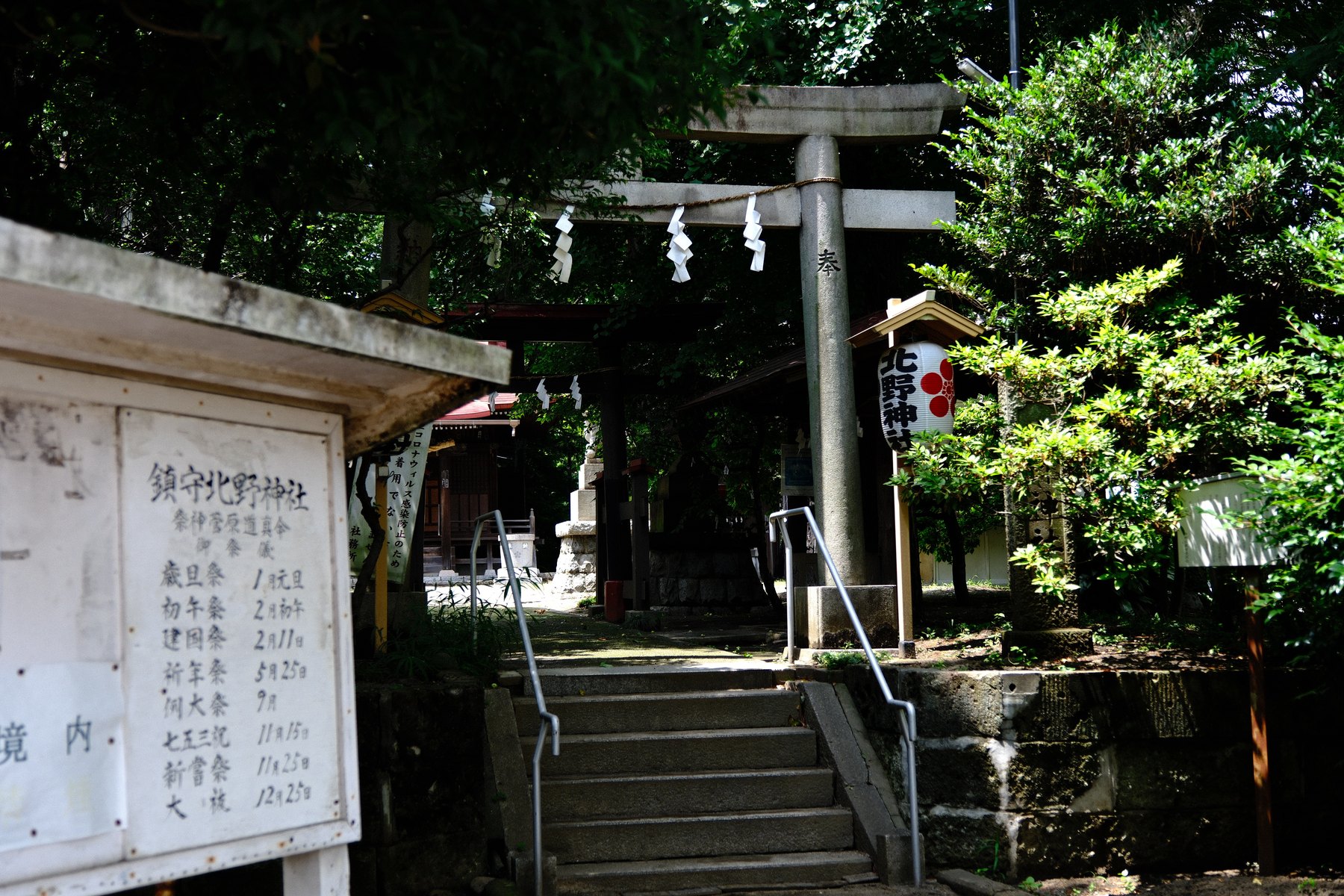
A neighborhood shrine can place white paper, pale stone, glossy leaves, and a dark interior in the same frame. The technical problem is dynamic range; the compositional problem is deciding whether the gate, path, or interior is the visual destination.
The X-H2 Dynamic Range settings are designed to reduce highlight detail loss in high-contrast scenes, with availability tied to sensitivity. They shape capture and camera rendering choices, but they do not remove the need to expose for the subject.
Decide where the frame should lead
Use the steps, handrails, or gate opening as a path toward one destination. If a foreground sign dominates without adding context, change position before relying on a crop.
Keep respectful distance from worshippers and restricted areas. A face-free architectural frame can still show use through objects, light, and spatial layers.
Protect the small bright details
Check the white paper streamers and sunlit stone rather than averaging the entire dark entrance. A small exposure reduction may preserve their shape while leaving the interior appropriately quiet.
If the important interior becomes unreadable, make a separate exposure test or return in softer light. Do not assume a slider can restore information that was not captured.
Correct perspective without sterilizing the scene
A slight upward camera angle can make verticals converge. Apply a restrained transform correction only after choosing the crop, and keep enough edge area to avoid cutting the gate or lantern.
Perfectly parallel lines are not mandatory. The correction should remove distraction while preserving the sense of standing below or approaching the structure.
Use masks for light zones, not symbolism
A luminance range can target a bright stone or deep entrance more precisely than a global shadow lift. Refine the edge around leaves and architectural details.
Describe the visible scene accurately. Avoid turning religious objects into generalized metaphors when the article is about exposure and composition.
Sources and further reading
References for the context and techniques discussed in this field note.