MODEAperture Priority
APERTUREf/1.4–f/2.8
MIN SHUTTER1/125 people · 1/60 quiet streets
AUTO ISO125–6400 to start
FILERAW + JPEG
There is no single correct exposure for Tokyo at night. A person crossing the frame, a still alley, and a bright convenience-store sign need different decisions. The useful goal is a setup that reacts quickly while protecting motion and highlights.
Start in Aperture Priority with a defined Auto ISO range
Use Aperture Priority when you are walking and the light changes block by block. Open the lens between f/1.4 and f/2.8, then let Auto ISO respond within limits you choose.
For a first setup, use the camera’s base ISO as the default, ISO 6400 as the maximum, and 1/125 second as the minimum shutter speed. Fujifilm’s Auto ISO system lets you set all three values. If the photograph remains underexposed at the maximum ISO, the camera may still choose a slower speed, so keep watching the display.
Camera behavior: Fujifilm X-H2 Owner’s Manual — Sensitivity
Choose shutter speed for the subject, not the focal length alone
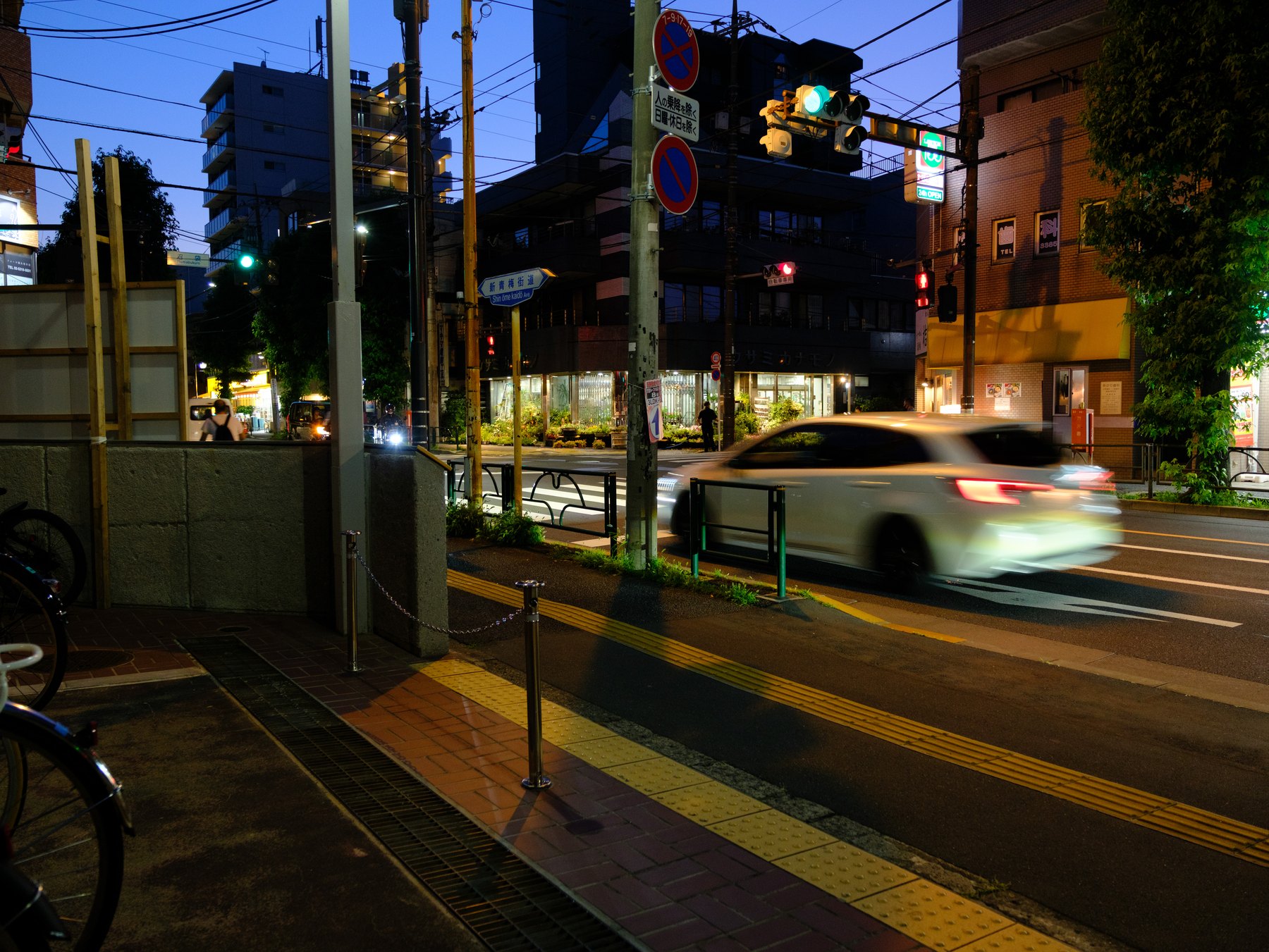
Use 1/125 second as a dependable starting point for pedestrians. Move to 1/250 when gestures or bicycles matter. For a quiet street with no moving subject, 1/60 can preserve a lower ISO; slower speeds become a deliberate motion choice, even when stabilization helps camera shake.
Review at full size occasionally. A sharp sign can hide a blurred face on the rear screen.
Raise ISO before accepting accidental motion blur
Noise is visible; missed focus and unwanted motion blur are usually harder to repair. ISO 6400 is a practical initial ceiling, not a rule. Raise the maximum to ISO 12800 when the moment matters more than clean shadows, then expose the subject instead of planning to lift a very dark RAW later.
Fujifilm notes that higher sensitivity can reduce blur in poor light, with increased mottling as the tradeoff. The X-H2’s standard still-photo range extends through ISO 12800.
Specifications: Fujifilm X-H2 technical specifications
Protect signs and lamps without flattening the night
Start around −1/3 EV when signs dominate, then judge the subject. Lower exposure compensation only when important highlights lose color—not simply because the histogram reaches the right edge. A dark street should remain dark.
Dynamic Range Auto is a useful safety setting when shooting JPEG alongside RAW. On the X-H2, DR200 and DR400 require higher minimum sensitivities, so changing dynamic range can also change the exposure options available.
Dynamic range behavior: Fujifilm X-H2 Owner’s Manual — Image Quality Setting
Use mechanical shutter around uncertain artificial light
Electronic shutter is quiet, but moving subjects can distort and some fluorescent or irregular lights can produce banding. When signs or indoor lighting create stripes, switch to mechanical shutter and test another shutter speed.
Shutter cautions: Fujifilm X-H2 Owner’s Manual — Shooting Setting
Keep white balance editable
Mixed light is part of the scene. Auto White Balance is fast, while a fixed Kelvin value makes a sequence more consistent. Either can work if you also keep RAW files. Do not neutralize every warm lamp or cool shadow; correct skin and familiar surfaces, then preserve the atmosphere.
For the Lightroom edit, follow the night color-grading workflow: correct exposure and white balance before shaping the color.
The compact setup
Save one Auto ISO preset for people at 1/125 and another for quiet scenes at 1/60. Aperture Priority handles changing streets; exposure compensation protects the light you care about; RAW keeps white balance open. That is enough to walk without living in the menu.