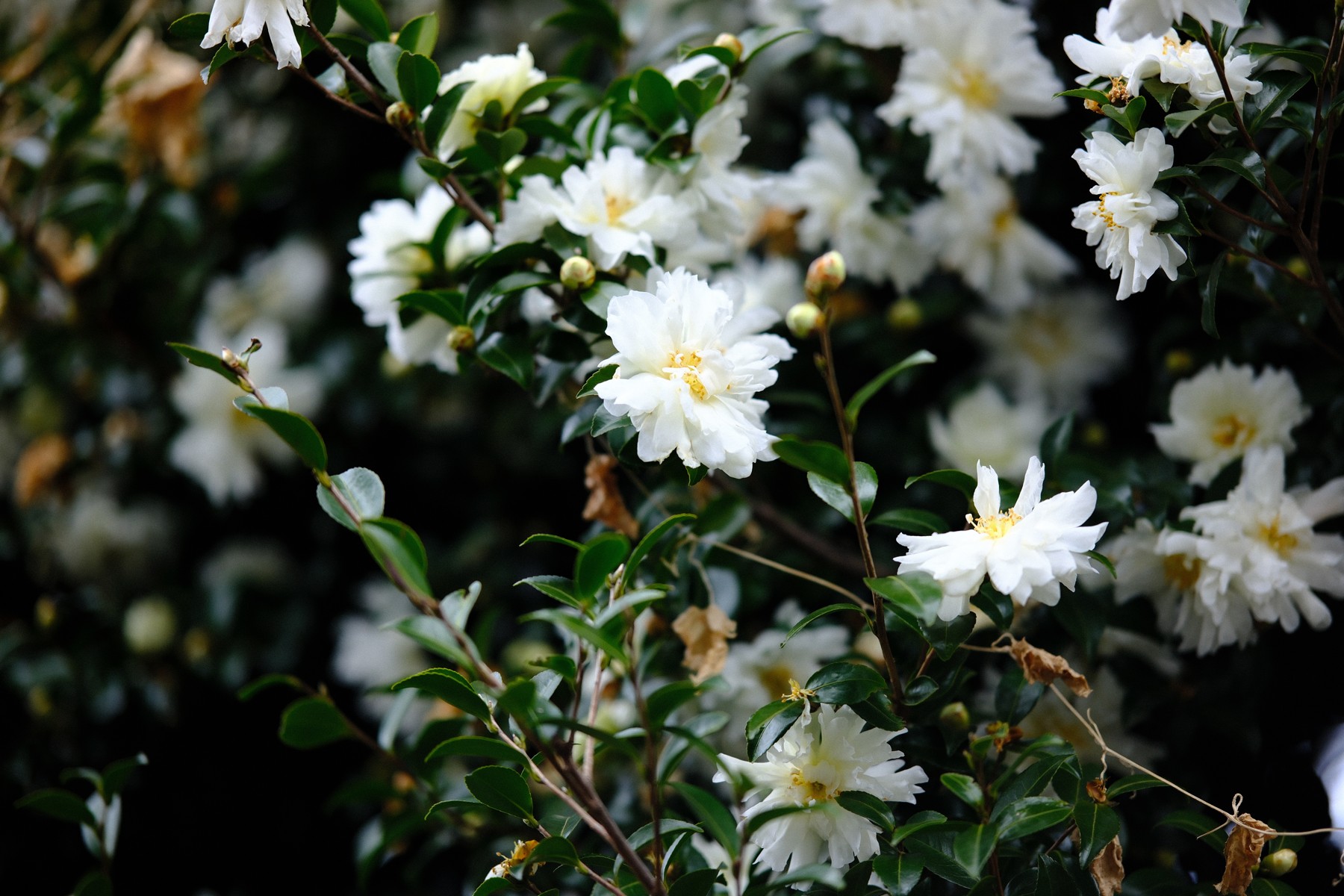
A flower against a pale sky asks the camera to average very different tones. The result may keep the sky while leaving the petals and foliage darker than intended, or make the foreground readable at the cost of a blank background. Exposure compensation is a way to tell an automatic exposure mode which compromise you actually want.
The X-H2 offers Multi and Spot metering, among other choices. Its manual notes that the selected photometry option takes effect only when face/eye and subject detection are off. Check those settings before assuming a metering change will behave as expected.
Choose the subject and accept a trade-off
For translucent petals, protect color and texture in the brightest petal before trying to open every shadow. For a silhouette of leaves, let the foreground go dark and preserve the shape against the sky. Both can be deliberate results.
Make a reference frame at zero compensation. Inspect the important highlight and subject on playback rather than judging only by the rear-screen brightness, which changes with ambient light. A small positive or negative adjustment is a starting test, not a fixed recipe.
Move compensation in the useful direction
In an automatic exposure mode, add positive compensation if the chosen subject is too dark; subtract it if the important petals or sky have lost recoverable detail. The X-H2 uses a command dial for compensation, and the available amount depends on shooting mode.
Reframe after each test and recheck the exposure. Multi metering can respond differently when the bright sky occupies more of the frame. Do not copy an EV value across every camera angle as though it were a property of the flower.
Separate capture from editing
Keep RAW+JPEG if you want the camera rendering as a reference and latitude for a later Lightroom interpretation. A Lightroom Highlights slider may recover a better-looking rendering, but cannot recreate sensor information absent from the file.
Set the raw profile and Exposure before deciding whether a local mask is needed. If the petals are good and only the background needs attention, a sky or brush mask is more targeted than a global darkening. Check the mask edge around small leaves.
A three-frame field test
Make three frames from the same position: meter-indicated exposure, one modestly brighter, and one modestly darker. Keep focus and composition steady. Compare the petal, the brighter background, and shaded leaves at the same viewing size.
Choose the frame whose important information survived capture. Save the compensation number as a note about this scene and framing—not as a universal Fujifilm setting.
Sources and further reading
References for the context and techniques discussed in this field note.