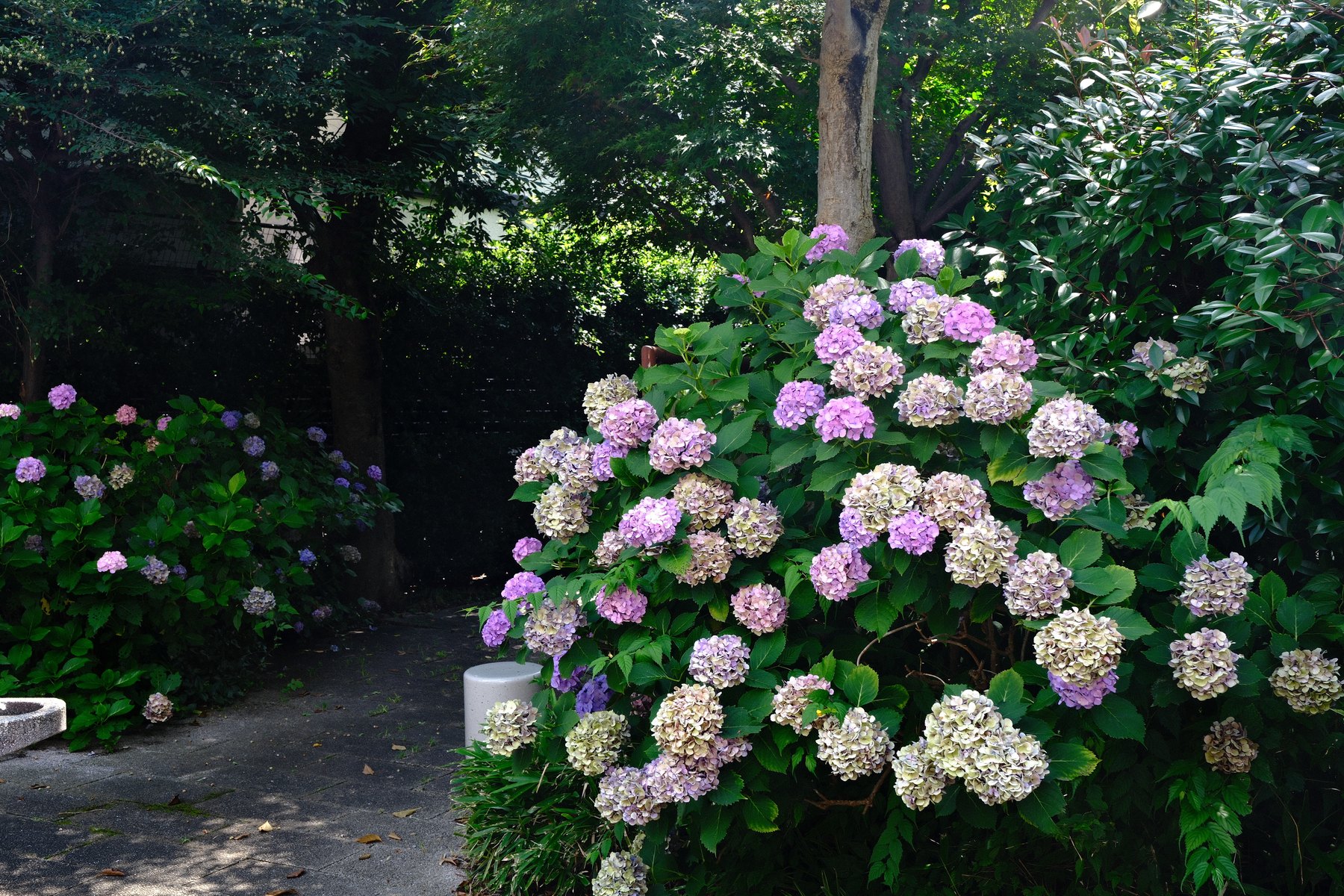
Hydrangeas invite a wide aperture because the background is busy, but a single flower head has depth of its own. If the focal plane touches only the nearest petals, the cluster may read as accidental softness rather than deliberate separation.
Choose whether the photograph is about one cluster, the relationship between two bushes, or the shaded path. Aperture follows that decision; it should not be selected only because a lens can open wide.
Pick the visual anchor before the aperture
Focus on a front-facing group of petals or the edge that defines the main cluster. Check whether the nearest and farthest parts needed for recognition sit within acceptable focus.
Stop down and test again if the subject fragments. A higher ISO can be a better compromise than an image whose descriptive petals fall outside the useful depth of field.
Use distance as a creative control
Moving slightly farther from the flowers increases practical depth and can simplify the relationship between the main cluster and background. Changing camera position often solves more than another aperture adjustment.
Keep the path or dark foliage as breathing space. Filling the frame with equal flower detail can remove scale and make every cluster compete.
Edit purple, faded petals, and foliage separately
Set profile and white balance first. Then sample purple, blue-violet, yellowing petals, and green leaves separately with Color Mixer or Point Color.
Do not push every faded bloom back to fresh purple. The variation carries season and condition; global saturation can erase that information.
Sharpen the chosen plane
Inspect the focused petals at 100% before adding sharpening. Use masking so leaves and dark background noise do not receive the same edge emphasis as the subject.
At export size, confirm that the main cluster remains legible without turning small petals into hard outlines. Keep grain and Texture subordinate to the flower structure.
Sources and further reading
References for the context and techniques discussed in this field note.